 Economy 51
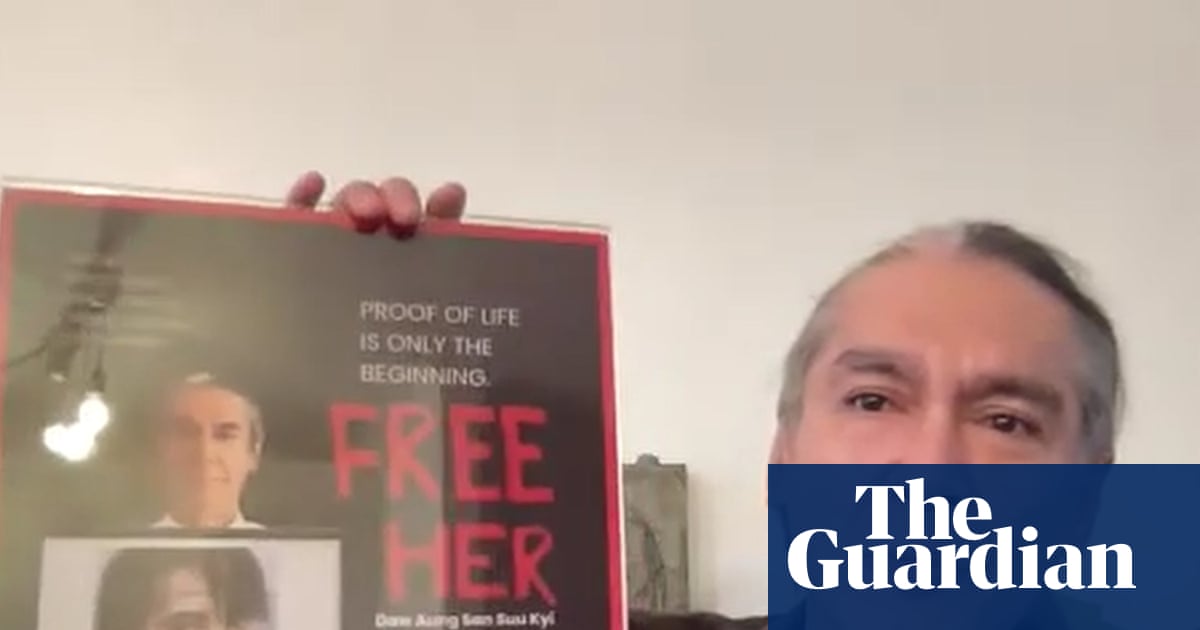
Myanmar’s former democratic leader Aung San Suu Kyi appears to be in good physical and mental health but is living in near-complete isolation, her son has said after the first call with his 81-year-old mother in more than five years. “She still sounds certainly all there mentally, and physically she sounds strong,” Kim Aris said. “I don’t think she has anybody outside of the military or the police around her, so essentially she’s been held in solitary confinement from what I gather.” After being deposed in a 2021 military coup , the Nobel Peace prize laureate has been moved to an unspecified location in the capital.
“I’m still not entirely sure where she is,” said Aris. “I think it’s a residence in Naypyidaw, which is fenced off and it has a scrubby bit of land around it.” Aung San Suu Kyi talks on the phone with her son on Thursday, in a photo released by the Myanmar presidential office. Photograph: Myanmar President Spokesperson Office/AP Aris, who has lived in the UK most of his life and whose late father was a British historian, was allowed to speak to his mother on Thursday at the Myanmar embassy in London .
While he welcomed the chance to talk, he said the invitation was part of a “public relations” campaign by the country’s military leaders. The former junta chief Min Aung Hlaing has sought to rebuild international diplomatic ties, and in April switched his military fatigues for civilian clothes after elections that were widely condemned as a sham . Activists have long demanded “proof of life” for Aung San Suu Kyi, as well as scores of other political prisoners.
In August, she was finally photographed during a Red Cross visit . Last week, a government spokesperson published images of her smiling in a wood-panelled room as officials delivered two gardening books given to her as gifts by Britain’s King Charles. A paper calendar on the wall behind her showed the date.
Aris said these photo-ops were well-known stunts that the regime had used before to pretend his mother, a national icon, was being treated fairly. The daughter of the assassinated national independence hero Gen Aung San has spent much of her life since the late 1980s in and out of house arrest for leading pro-democracy movements. “She remains completely shut off from the rest of the world.
I think she’s unaware of what’s happening outside of where she is because she’s not allowed any newspapers or radio or television,” Aris said. “She’s been locked up for five years on trumped-up, politically motivated charges and she should be free.” Ruled for decades by generals and suffering from western sanctions, Myanmar experienced a brief democratic moment after Aung San Suu Kyi was allowed to run in a 2015 election that her party overwhelmingly won . She took up the role of “state counsellor” under a civilian-military power-sharing agreement.
Aung San Suu Kyi shakes hands with Myanmar’s military commander-in-chief Min Aung Hlaing (left) in December 2015. Photograph: Lynn Bo Bo/EPA Her international reputation was soon tarnished after the 2016-2017 mass killings and expulsions of Rohingya Muslims . Aung San Suu Kyi flew to the international court of justice in The Hague, where she said she acknowledged military units might have used “disproportionate force”, but defended the government against accusations of genocide.
Aris said that his mother was never “silent” on the Rohingya crisis and what she said on the issue “could fill volumes”. Under her leadership, Myanmar launched a domestic inquiry and appointed the former UN chief Kofi Annan to head a commission. He added that as state counsellor, Aung San Suu Kyi was “always walking on a tightrope”, knowing the military could strip her of her fragile power at any moment.
“The very hard-won nascent democracy that she was trying to lead was holding on to things by a thread,” he said. “The military could have taken over at any point, and they were doing their best to make my mother’s situation a lot more difficult and to undermine her position. And I think in that respect they did a pretty good job.” The 2021 power grab by the military triggered a civil war that has killed more than 100,000 people, according to conflict monitors.
Aris said the level of public global support for his mother had “dwindled incredibly” since the Rohingya crisis and that the whole country was now suffering from a lack of international attention. While many governments have called for Aung San Suu Kyi’s release, she is not treated as the beloved international figure that she once was. “Never mind my mother, the fact that people ignore what’s happening in Burma shouldn’t be down to what was being done to the Rohingya,” he said, using the country’s former name.
“And that seems to be the case sometimes, that people say: ‘Oh, well, look how the Rohingya were treated. We can ignore what’s happening in Burma.’”
Source: The Guardian